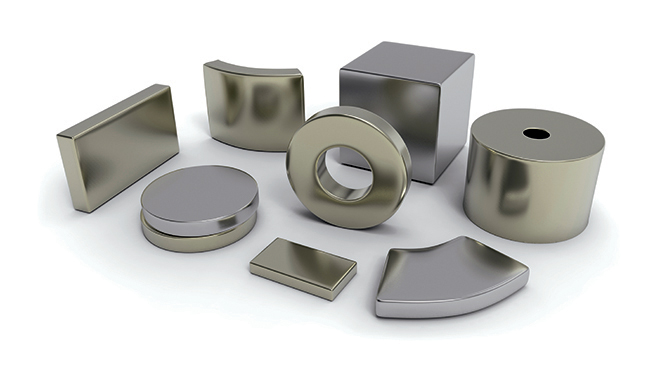
Researchers from the DOE’s Critical Materials Institute (CMI) and Ames National Laboratory have developed a new method of manufacturing manganese bismuth (MnBi) magnets based on microstructure engineering.
They describe their wok in “Engineering microstructure to improve coercivity of bulk MnBi magnet,” published in the Journal of Magnetism and Magnetic Materials.
Permanent magnets used for electric motors are currently constructed from rare earth elements such as neodymium and dysprosium, which, according to researchers, are becoming increasingly harder to obtain. According to Wei Tang, a CMI researcher and Ames Lab scientist, by improving the properties of a rare-earth-free permanent magnet material such as MnBi, the researchers have made a step towards making compact motors without using rare earths.
Permanent magnets used for electric motors require high energy density or high levels of magnetism and coercivity—a magnet’s ability to maintain its current level of magnetism despite exposure to high heat and outside influences that could demagnetize it. The challenge with MnBi is that traditional manufacturing methods require high heat to transform the individual materials into a magnet, and the necessary heat reduces the energy density of the magnet. To address this problem, the team developed an alternative process.
Tang and his team started with a fine powder for each of the materials, which increases the starting magnetic energy level. Next, they used a warm heating method rather than a high-temperature method for forming the magnet. Finally, the key to their new process was to add a non-magnetic component that would keep the grain particles from touching each other. This additional element, called a grain boundary phase, provides more structure to the magnet and keeps the magnetism running through individual particles/grains from affecting adjacent areas.
The researchers expected the coercivity and magnetism to decrease with increasing temperature, which is true for most magnetic materials. However, for MnBi, the warm temperature increased the coercivity and decreased the magnetization. This increased coercivity helps to keep the magnet more stable at elevated temperatures than other known magnets.
“If we use high-power-density magnets, we can reduce the motor size and make a more compact motor,” said Tang. “Right now, it is very important that we can make some devices smaller, more compact and more energy-efficient.”
Source: Ames National Laboratory