
The race to bring affordable and actually usable EVs to the market is heating up in Europe, with more and more big automakers rolling up their sleeves and doing everything in their power to launch sub-$25,000 models as soon as possible.
Now, two of the biggest carmakers from South Korea and China want to send their best battery-powered urban EVs to Europe to battle local competitors such as the Chinese-built Dacia Spring and French-built Citroen e-C3.
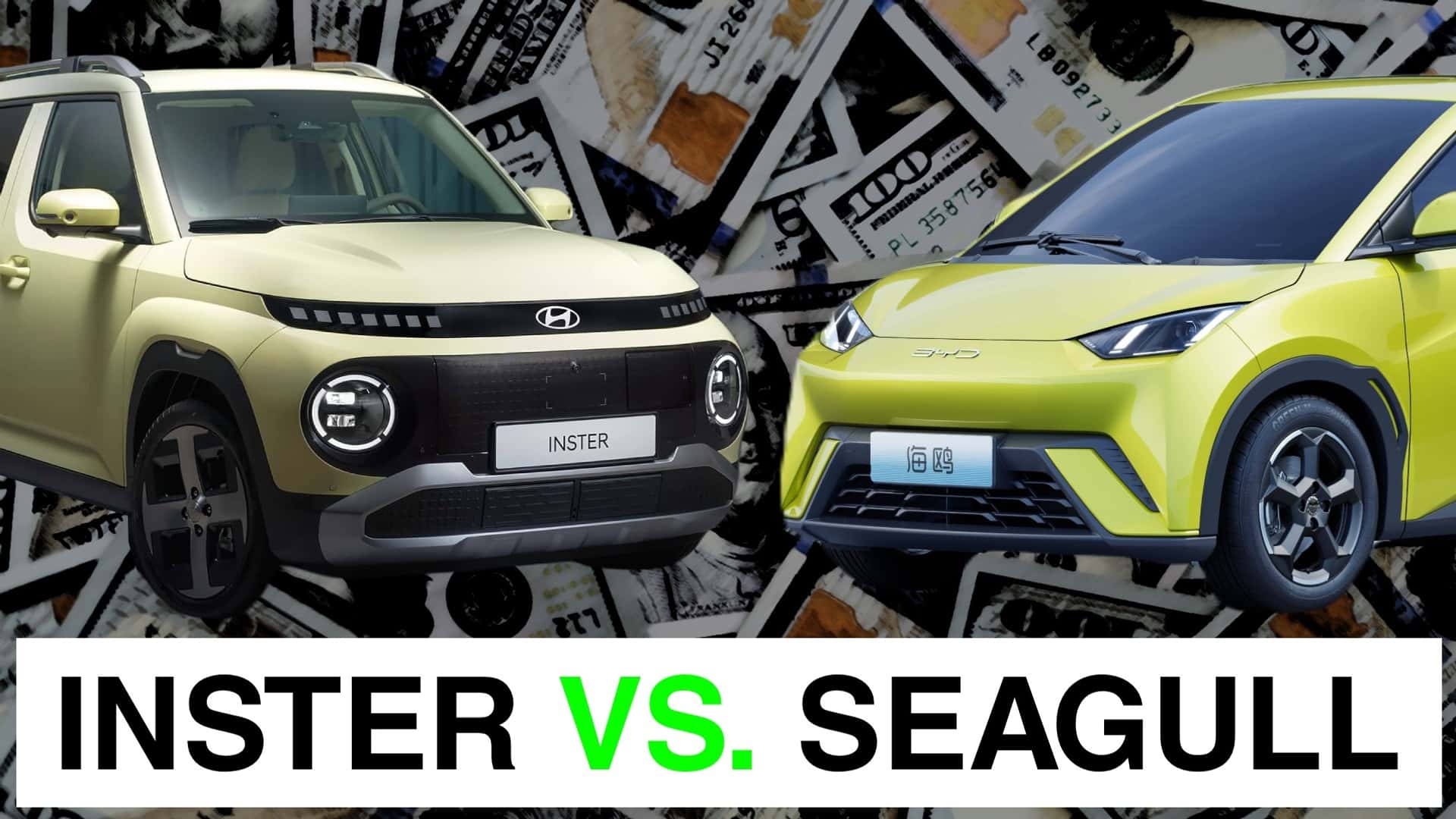
Welcome, then, to the specs comparison between the brand-new Hyundai Inster, which was revealed just a couple of days ago, and the BYD Seagull, which has seen massive success in its home country, selling over 200,000 units in its debut year, and has its sights set on the European market starting next year.
It’s worth noting that neither EV is coming to the United States, soon or probably ever. The U.S. market is dominated by big vehicles and road-tripping machines. These subcompacts for Europe make plenty of sense for customers who live in big cities and rarely need to get out of town or use a rail system when they do. Plus, while Hyundai is having a moment in the U.S., harsh new tariffs on Chinese-made cars will keep BYD out for some time.
But both the Inster and the Seagull are important machines globally, and they say a lot about where the electric market is headed next—smaller, more affordable, but still high-range and high-tech. We know that BYD is already a powerhouse in the EV world. As good as the Koreans are, do they have what it takes to keep up? Let’s find out.

Dimensions
Both the Inster and the Seagull are categorized as A-segment cars in Europe, but their wheelbases are arguably comparable to vehicles one step above. Think Chevrolet Bolt EV or the defunct gas-powered Ford Fiesta.
This means that, even though they have a small footprint, their interior is bigger than you’d expect. With that said, out of the two pint-sized EVs, the Hyundai Inster inches ahead when it comes to size, being longer, taller and with a more generous wheelbase than its Chinese rival.
The Inster also offers a bigger trunk of up to 12.3 cubic feet with the two sliding rear seats in their most forward position. On the other hand, the BYD seagull is four inches wider than its Korean rival, which could help with shoulder room inside.
| Model | Length | Width | Height | Wheelbase | Weight | Luggage space |
| Hyundai Inster | 150.9 in | 63.3 in | 62 in | 101.5 in | N/A | Up to 12.3 cu ft |
| BYD Seagull | 148.8 in | 67.5 in | 60.6 in | 98.4 in | 2,557-2,733 lbs | 10.5 cu ft |
Battery and range
Driving range is one of the most, if not the most important figures prospective customers look at when researching EVs. But in the car world, it depends on what market you’re looking at, as you might stumble across some impressive but rather unrealistic numbers.
Case in point: the BYD Seagull has a maximum advertised range of 252 miles on a full charge, but that’s on the very lenient Chinese test cycle which is known to produce figures that are nearly impossible to reach in the real world.
That said, the WLTP ratings for the Hyundai Inster aren’t exactly real-world material either, but they’re a bit closer to what one might expect on the road. Looking at the battery capacity figures might be a better metric to understand how far a car could go on a full charge.
The BYD Seagull can be specced with either a 30-kWh or a 39-kWh lithium iron phosphate (LFP) battery pack rated at roughly 400 volts, whereas the Hyundai Inster is offered with a 42-kWh or a 49-kWh nickel manganese cobalt (NMC) unit rated between 266V-310V.
In theory, the Inster should offer more driving range in the real world, with Hyundai quoting a projected WLTP rating of up to 220 miles for the Long Range version with 15-inch wheels.
| Model | Battery capacity (gross) | Nominal voltage | Range | Energy consumption | DC fast charging | AC charging |
| Hyundai Inster | 42 kWh (Standard) or 49 kWh (Long Range) | 266V (Standard), 310V (Long Range) | 220 miles (Long Range with 15-inch wheels) WLTP (projected) | 4.06 miles/kWh (projected) WLTP | 10%-80% in 30 minutes | 11 kW, 4 hours and 35 minutes for the Long Range, 4 hours for the Standard |
| BYD Seagull | 30.08 kWh or 38.88 kWh | 403V | 190 miles or 252 miles CLTC | 6.82 miles/kWh CLTC | 30%-80% in 30 minutes | 6.6 kW |
Performance
When talking about affordable city cars, you can’t expect supercar-like performance specs, and it’s no different with the two pint-sized EVs. You rarely, if ever, need to sprint to 60 miles per hour in an urban area, but if numbers make or break your day, you should know that the Inster beats the Seagull once again, with a 0-62 mph sprint in 10.6 seconds for the Long Range version, which comes with a 95 horsepower front motor. By contrast, the 74 hp BYD needs 13 seconds to get to 62. In the top speed department, Hyundai’s entry-level EV again comes up on top, with up to 93 mph for the Long Range version.
Model | Layout | Power | Torque | Acceleration | Maximum speed |
| Hyundai Inster | FWD | 95 hp (Standard), 113 hp (Long Range) | 108 lb-ft | 0-62 mph in 11.7 s (Standard), 10.6 s (Long Range) | 87 mph (Standard), 93 mph (Long Range) |
| BYD Seagull | FWD | 74 hp | 99 lb-ft | 0-62 mph in 13 s | 81 mph |
Features
Nowadays, customers want more of everything, even when looking at budget EVs. This means that the driving range isn’t the only deciding factor and that a car needs to have a healthy list of amenities to attract prospective buyers.
On paper, the Hyundai Inster gets ahead of the BYD Seagull once again. The Korean EV boasts two 10.25-inch screens, a heat pump, a wireless smartphone charger, vehicle-to-load and a comprehensive advanced driving assistance systems list as standard. By comparison, the China-market BYD Seagull doesn’t have V2L or a heat pump in its home market.
Furthermore, the Seagull has a single 10.1-inch central display for the infotainment and only the most expensive trim offers a wireless smartphone charger. Both EVs have a foldable rear bench, but the Inster’s can be split 50/50, while the Seagull’s is a single backrest.
That said, it’s unclear at the moment if the European version will carry over the Chinese version’s trim levels. At home, the Seagull starts at the equivalent of roughly $12,000, while the European version is expected to cost double, but that includes the value-added tax (VAT) and import tariffs.
39 Photos
| Model | Vehicle-to-load (V2L) | Wireless smartphone charger | Screens | Seats | A/C | Heat pump |
| Hyundai Inster | Yes | Yes | Dual 10.25-inch | 4 | Yes | Yes |
| BYD Seagull | No | Yes, but not standard | 7-inch digital gauge cluster, 10.1-inch rotating infotainment screen | 4 | Yes | No |
Price
The cheapest new EV on sale in the European Union is probably the refreshed Dacia Spring, which starts at around €16,000 ($17,200). For this kind of money, you get a no-frills urban runabout with just 44 hp and a WLTP range of about 140 miles.
With that said, both Hyundai and BYD will likely aim toward a slightly higher price segment once the Inster and Seagull hit European streets later this year and early next year, respectively.
20 Photos
Neither the Seagull nor the Inster have official pricing, but company officials went on record saying that the sweet spot would be somewhere around the €20,000 ($21,500) mark. That would be 25% more than the Dacia Spring, but looking at the spec sheets of all three cars, the Spring is the most basic one out of the bunch, with the least powerful electric motor and the least driving range. On the other hand, it comes with a frunk, which neither the Inster nor the Seagull have, and vehicle-to-load.
Which car is destined to be the real winner in the EV subcompact space? Let us know what you think.
| Model | Estimated starting price in Europe |
| Hyundai Inster | €20,000 ($21,500) |
| BYD Seagull | €20,000 ($21,500) |