


After about a year of silence, Tesla released a new version of its Vehicle Safety Report, providing interesting new data. The voluntarily published quarterly reports give us glimpses of how Autopilot improves vehicle safety.
The new report contains reviewed and updated data about the number of miles driven per one accident registered when using Autopilot technology, not using Autopilot technology, and the US average (NHTSA and FHWA data) as a background.
New numbers for the period 2018-2021 are different (higher) than before because Tesla discovered issues in the old data (some accidents were counted more than once). Without the duplicated data, the results are actually better than previously (see full explanation at the bottom).
An important thing is that Tesla counts all accidents, regardless of the cause, despite that more than 35 percent of all Autopilot crashes occur when the Tesla vehicle is rear-ended by another vehicle, the company says.
Let’s get into the details.
According to Tesla, the number of miles driven per one accident registered, when using Autopilot technology, is consistently increasing, which indicates that cars are getting safer to use.
In Q3, the company noted one accident per 6.26 million miles driven – a 13 percent increase year-over-year. The record result was noted in Q1, at 6.57 million miles driven.
What is really important is that using the same methodology, the result is almost two times higher than four years ago (3.35 million miles per one accident in Q3 2018).

Without using Autopilot technology, Tesla vehicles statistically note more accidents. In Q3 2022, it was one accident per 1.71 million miles driven (8 percent more than a year ago).
There is a significant difference between the two modes of driving (with or without Autopilot) and the difference is increasing, as there is not that much progress in the case of driving without Autopilot.
However, we must note that the two data sets should not be compared against each other, besides a brief look to have some idea of the numbers.
It’s important to note that the results are comparable only within a particular category (Autopilot or without Autopilot), not between the categories as the input data might be widely different (like simple highway driving or complex city driving). In other words, we can only see whether the active safety systems are improving over time (and it’s also only a rough comparison), but we can’t compare Autopilot to non-Autopilot driving.
We assume that the proper use of Autopilot improves safety, but Tesla’s report does not allow us to evaluate the difference.
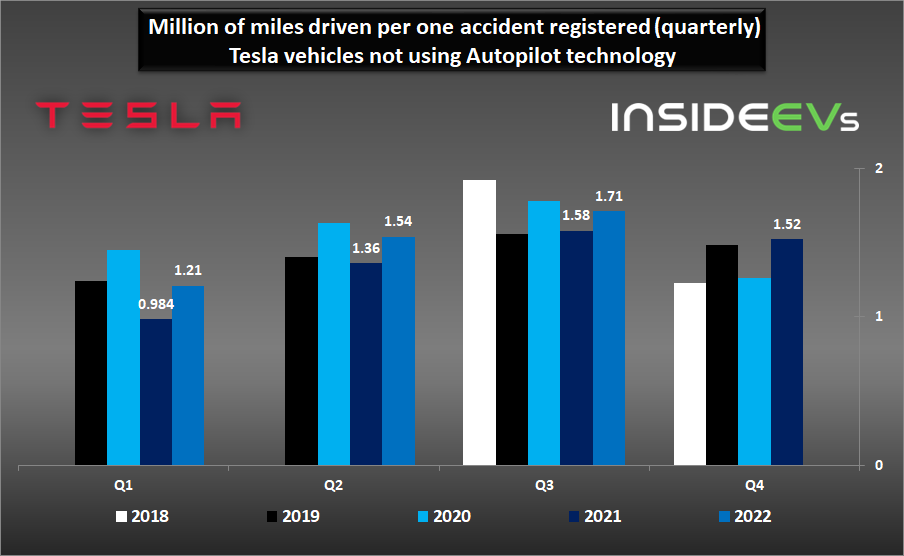
And below we attached a full chart with all numbers provided by the manufacturer plus NHTSA and FHWA data about the average distance between an automobile crash in the United States.
The difference is pretty huge, but once again, we shouldn’t really compare the numbers directly. The US average includes also a much older vehicle fleet (with less safety systems), which alone is a big factor. The US average currently appears to be almost a third better than four years ago (0.652 million miles vs. 0.492 million miles).

Tesla has its own version of the chart:

Important factors:
- data for each setting might be collected at different driving scenarios (like simple highway driving or complex city driving), which makes the results incomparable between the categories
- results might be affected by various factors, including seasonality (reduced daylight, weather conditions), less driving during lockdown
- NHTSA and FHWA average for the US (updated rarely) includes all cars, also old
- Tesla’s info about the methodology of registering accidents:
“We collect the amount of miles traveled by each vehicle with Autopilot active or in manual driving, based on available data we receive from the fleet, and do so without identifying specific vehicles to protect privacy. We also receive a crash alert anytime a crash is reported to us from the fleet, which may include data about whether Autopilot was active at the time of impact. To ensure our statistics are conservative, we count any crash in which Autopilot was deactivated within 5 seconds before impact, and we count all crashes in which the incident alert indicated an airbag or other active restraint deployed. (Our crash statistics are not based on sample data sets or estimates.) In practice, this correlates to nearly any crash at about 12 mph (20 kph) or above, depending on the crash forces generated. We do not differentiate based on the type of crash or fault (For example, more than 35% of all Autopilot crashes occur when the Tesla vehicle is rear-ended by another vehicle). In this way, we are confident that the statistics we share unquestionably show the benefits of Autopilot.” - assuming the methodology was not changed, we can see how each category improves over time
Tesla’s explanation of data update:
“…we discovered reports of certain events where no airbag or other active restraint deployed, single events that were counted more than once, and reports of invalid or duplicated mileage records. Including these events is inconsistent with our methodology for the Vehicle Safety Report and they will be excluded going forward. These upgrades in data analysis reinforce the positive impact that Autopilot has on vehicle safety.
To ensure the accuracy of our reporting, we updated all collision rates historically to account for these upgrades, including the baseline collision rates for the United States based on currently available NHTSA and FHWA data.
(Note that for purposes of the baseline collision rates in the United States, an automobile crash is one that involves at least one passenger vehicle, light truck, SUV or van that is 10,000 pounds or less, as classified by available federal data.) The end result is that, when Autopilot is active, the collision rates are even lower than we previously reported.”


