
We’ll be frank — we have some of the coolest jobs out there. But the engineers at car safety labs might have it even better than we do. How much stress can you carry if you can crash a pickup truck into a wall once a day?
We’re amazed they don’t charge to let people in. For a fee, you could spray paint the names of your stressors onto a Buick and hit the button to send it flying into thousands of pounds of steel. They’d all be millionaires.
But their work is serious and has important outcomes that make us all safer. And their work is about to get a little harder. So, they’re getting ready.
How is car safety about to get more complicated? Because of weight and the laws of physics.
Electric cars are much heavier
Raul Arbelaez, vice president of the Vehicle Research Center at the Insurance Institute for Highway Safety (IIHS), explains that, with electric vehicles becoming common, battery weight is “pushing vehicle mass higher.”
The IIHS, incidentally, is private industry’s auto safety testing lab. It’s funded by a consortium of insurance companies, and has a reputation for performing the toughest safety tests in the auto industry.
The heaviest vehicle the IIHS ever tested, Arbelaez says, is a larger electric SUV, the 2019 Audi e-tron. That vehicle, as tested, was “under 6,000 pounds.” But, he says, “some of these electric vehicles that have been advertised as coming in the next few years” are significantly heavier, “one as high as 9,500 pounds.”
Arbelaez doesn’t name it, but he’s almost certainly discussing the GMC Hummer EV. Its battery, GM
GM,
says, can weigh 2,923 pounds – more than a Mazda Miata. That’s the battery alone.
See: Should you trade in your old car to get the latest safety features?
The crash machine can handle it
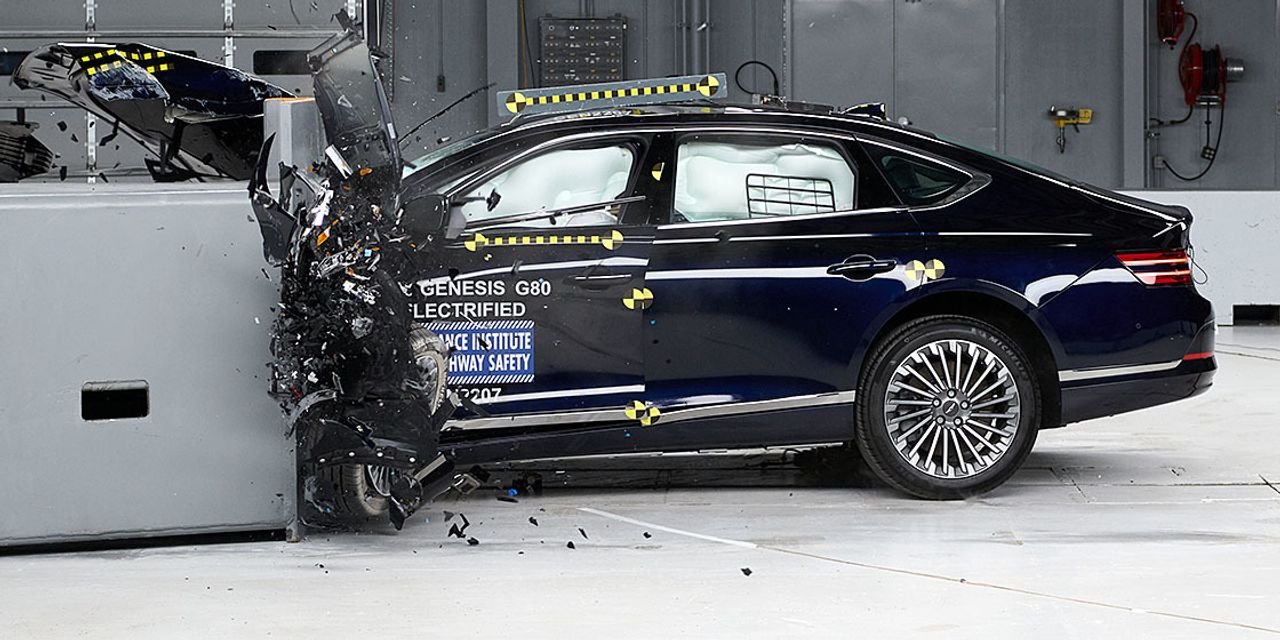
IIHS engineers needed to verify that their crash machine — yes, they call it a crash machine — could handle it.
Crash test engineers don’t use a car’s own engine to get it up to testing speed. To control the conditions of a crash as best they can for repeatable results, they connect each car to a cable that tows it up to testing speed – about 40 mph in the institute’s fastest tests.
Engineers needed to ensure that their equipment could get a 9,500-pound vehicle up to 40 mph in the 600 feet allotted before it hit the test barrier.
To get there, they took what Arbelaez calls “some old junkers” and loaded them with steel plates and heavy concrete barriers to get their weight up to “about 9,500 pounds” before sending them rocketing toward a wall.
The crash machine held up just fine. It’ll hurl a Hummer.
Related: New electric car buying incentives kick in Jan. 1, and a lot has changed. Here’s an explainer.
But car safety faces new challenges
It’s comforting to know that EVs will face the same tests as gas-powered cars. But the fact that the IIHS worried it might need to build new equipment to accommodate them illustrates something important.
At the rate the auto industry is modernizing toward EVs, almost all of us will be driving them someday. But there will inevitably be an overlap period when some cars on the road are electric, and others are gas-powered.
In an accident, weight matters. If you doubt it, watch videos of the time the IIHS crashed large cars into small cars. Those tests look radically different than tests of a car crashing into a barrier. The larger vehicles often stay in their lane while sending smaller cars well out of theirs.
Plus: Tesla’s approval rating sinks into negative territory, survey finds
Crash tests can only estimate the likelihood of injury to someone inside the tested car. They can’t predict injuries in the other car. And we’re all about to share the roads with other cars that dramatically outweigh ours.
Safety engineering is about to get a lot more complicated.
This story originally ran on KBB.com.