
Tesla has applied for a set of patents that are set to significantly improve virtualization, recognition, and Full Self Driving overall.
Tesla has worked tirelessly to improve full self-driving technology in the first two months of the year. Most recently, Tesla pushed its most significant improvement to employees, v11.3. Still, with new patented technology, the software is set to continue to improve dramatically this year. The two patents, focusing on virtualization and machine learning, appeared in the U.S. Patent Office database late last week.
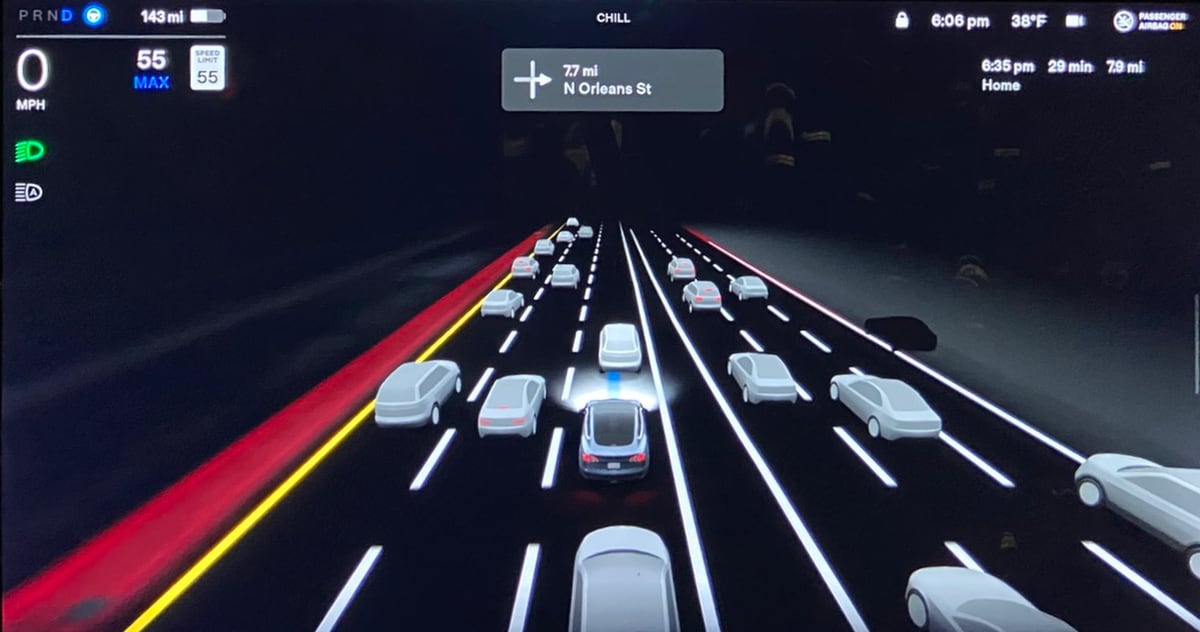
The first patent, “Vision-Based Machine Learning Model for Autonomous Driving with Adjustable Virtual Camera,” is likely simply a reworking of a previous system but changed to fit Tesla’s new visual-only autonomous driving system. The second patent, “Vision-Based Machine Learning Model for Aggregation of Static Objects and Systems for Autonomous Driving,” focuses more on improving the virtualization seen on screen while in the vehicle.
The first patent’s abstract describes a system that looks similar to the one already available in Tesla vehicles but has been adapted to remove non-visual sensors. However, it does include an added “adjustable virtual camera,” potentially indicating that Tesla is working to give drivers more control of looking out of their car with the camera system or improved virtualization interaction.
“Systems and methods for a vision-based machine learning model for autonomous driving with adjustable virtual camera. An example method includes obtaining images from a multitude of image sensors positioned about a vehicle. Features associated with the images are determined, with the features being output based on a forward pass through a first portion of a machine learning model. The features are projected into a vector space associated with a virtual camera at a particular height. The projected features are aggregated with other projected features associated with prior images.”
The second, significantly more extensive patent is described in its abstract, focusing on the “aggregation of static objects” by the vehicle:
“Systems and methods for a vision-based machine learning model for aggregation of static objects and systems for autonomous driving. An example method includes obtaining images from image sensors positioned about a vehicle. Features associated with the images are determined, with the features being output based on a forward pass through a machine learning model. The features are projected into a vector space associated with a birds-eye view based on the machine learning model.”
If anything, the new patents from Tesla show just how dedicated it is to its visual-only system. Nowhere in either of the patents does the automaker address other sensor inputs, which seems to line up with recent discoveries showing upcoming vehicles without ultrasonic sensors.
Further, with Tesla’s increasing focus on making vehicles more AI capable, implementing improved machine learning also matches its design goals.
It remains unclear whether these improvements have been implemented in upcoming software versions or have already been placed in cars via recent software updates. Still, they nonetheless indicate that the company is making continuous progress in its pursuit.
As more and more automakers enter the autonomous driving competition, Tesla’s lead becomes ever more apparent. And while many have mocked the company for its dedication to AI over just vehicles, that investment is proving to be a fantastic one. Hopefully, it will result in an increasingly better Tesla driving experience in the coming years.
What do you think of the article? Do you have any comments, questions, or concerns? Shoot me an email at william@teslarati.com. You can also reach me on Twitter @WilliamWritin. If you have news tips, email us at tips@teslarati.com!